
NAPPS SCHEME OF WORK SECONDARY 1ST TERM (JSS1 -JSS3)
1ST TERM
ENGLISH STUDIES
| WEEKS | Jss 1 | Jss 2 | Jss 3 |
| 1 | 1.1 SPEECH WORK: i) Introduction to speech ii) Organs of speech 1.2 GRAMMAR: Parts of speech i) Nouns-Meaning ii) Types of Nouns with examples 1.3 READING & COMPREHENSION: The Family (use any of the recommended texts for JSS 1 Vocabulary Development: Introduction to Language Skills: Listening Skills; Speaking Skills; Reading skills; Writing Skills. 1.4 COMPOSITION: Meaning, types of composition (Narrative, Descriptive, Argumentative, Expository). 1.5 LITERATURE IN ENGLISH: What is Literature? The Features of Literature. 1.6 TYPES OF LITERATURE: – Oral, Historical, Dance Drama, Miming… with reference to related texts. | 1.1 SPEECH WORK: Listening and Speaking: Revision of pure vowel sounds. 1.2 GRAMMAR: Revision of Parts of speech: Nouns, Pronouns, Verbs and Adjectives. 1.3 READING & COMPREHENSION: Review of the SPQ3R reading technique. 1.4 COMPOSITION: Writing an outline for a Narrative Essay – How I spent My Last Holiday. 1.5 LITERATURE IN ENGLISH: Revisit Features of Prose (Setting, theme, characterization ….) 1.6 TYPES OF LITERATURE: – Figures of Speech: Alliteration, Personification. | 1.1 REVISION OF LAST TERM’SEXAMINATION. 1.2 GRAMMAR: Parts of Speech Revision. 1.3 READING & COMPREHENSION: Scanning for main points. 1.4 COMPOSITION: Informal Letter – Letter to my best friend on my plans for this academic session. 1.5 LITERATURE IN ENGLISH: Introduction to Fiction and Non-Fiction. 1.6 TYPES OF LITERATURE: – Examples of Non-fiction. |
| 2 | 2.1 SPEECH WORK: i) Pure Vowel Sounds (Monothongs) Examples 2.2 GRAMMAR: Pronouns (i) Meaning, Identification. ii) Types of Pronouns. 2.3 READING & COMPREHENSION: Reading strategies (SPQ3R) – Survey Preview, Question, Recite, Recall, Review. Vocabulary Development: Members of the Family. 2.4 COMPOSITION: Elements of Composition: Introduction, Body and Conclusion. 2.5 LITERATURE: Purpose/Functions of Literature. 2.6 LITERATURE: – Introduction to Prose – Use the recommended text. | 2.1 SPEECH WORK: Revision of Consonant sounds with emphasis on consonant clusters. 2.2 GRAMMAR: Transitive and Intransitive Verbs. 2.3 READING & COMPREHENSION: Reading to understand the writer’s purpose. 2.4 COMPOSITION: Descriptive Essay: Writing an outline on A Place of Interest I visited. 2.5 LITERATURE: Use the recommended text on Prose. 2.6 LITERATURE: Same as in 2.5. | 2.1 SPEECH WORK: The skew /Ə/ sound –about, doctor, above. 2.2 GRAMMAR: Expressing/describing emotions (verb + preposition) 2.3 READING & COMPREHENSION: Skimming for specific information. 2.4 COMPOSITION: Writing to a pen-pal. 2.5 LITERATURE: Poetry analysis. 2.6 LITERATURE: Use the recommended text on prose. |
| 3 | 3.1 SPEECH WORK: Vowel /i:/ 3.2 GRAMMAR: Verbs: i. Definition, Identification with example. ii. Types of Verbs: Transitive, Intransitive, Regular, Irregular, Auxiliary, lexical. 3.3 READING & COMPREHENSION: Identification of main/supporting ideas. Vocabulary Development – Your School Subject. 3.4 COMPOSITION: Outlining the differences between Descriptive Essays and Narrative Essays. 3.5 LITERATURE IN ENGLISH: Introduction to the elements of Prose (Plot, Style, Characterisation) 3.6 TYPES OF LITERATURE: – Types of Oral Literature. | 3.1 SPEECH WORK: Listening and Speaking – The /IƏ / Sound (ear, clear, hear, bear) 3.2 GRAMMAR: More on Active and Passive Voice. 3.3 READING & COMPREHENSION: Identification of words that points to the writer’s intention on contemporary issues like corruption. Vocabulary Development – Word Families – In The Hospital. 3.4 COMPOSITION: Elements of Composition: Pre-Writing, writing, editing, body and conclusion. 3.5 LITERATURE IN ENGLISH: Features of Folktales (didactic, entertaining, riddles, ..) 3.6 TYPES OF LITERATURE: – Use the recommended text on Prose. | 3.1 SPEECH WORK: Stress and intonation continued. 3.2 GRAMMAR: Adverb of frequency-(often, always, occasionally). 3.3 READING & COMPREHENSION: Reading to cultivate the skill of referencing. 3.4 COMPOSITION: Write a story on the topic – All that glitters is not gold. 3.5 LITERATURE IN ENGLISH: Use the recommended text on Prose. 3.6 TYPES OF LITERATURE: – Characterization, Theme, Plot in the prose text. |
| 4 | 4.1 SPEECH WORK: Vowel /I/ 4.2 GRAMMAR: Adjectives: i. Definition, Identification. ii. Types of Adjectives. 4.3 READING & COMPREHENSION: Reading to answer specific questions: test for knowledge level and translation level. 4.4 COMPOSITION: Narrative Essays- My Experience in Former School 4.5 LITERATURE-IN-ENGLISH: Use the recommended text on Prose. 4.6 LITERATURE – IN ENGLISH – Features of Oral Literature. | 4.1 SPEECH WORK: Vowel /Əu/ sound (go, blow, mow, know, ..) 4.2 GRAMMAR: More on Tenses (Present, Past and Future) 4.3 READING & COMPREHENSION: Critical reading: Meaning and steps of critical reading. Vocabulary development: Word Families: The Officer’s Job. 4.4 COMPOSITION: Descriptive Essays- A Local Festival 4.5 LITERATURE-IN-ENGLISH: Use the recommended text on Prose. 4.6 LITERATURE – IN ENGLISH – AS in 4.5 | 4.1 SPEECH WORK: Consonants /Ɜ/ and /dꞫ/ (leisure/ ledger, garage, large) 4.2 GRAMMAR: Changing Positive statements to negative statements using ‘not’. 4.3 READING & COMPREHENSION: Practise scanning, skimming and normal rate reading. 4.4 COMPOSITION: How to care for a motor vehicle. 4.5 LITERATURE-IN-ENGLISH: Comprehensive study of the Prose text. 4.6 LITERATURE – IN ENGLISH – Introduction of rhyme scheme. |
| 5 | 5.1 SPEECH WORK: Vowel /e/ 5.2 GRAMMAR: Comparison of Adjectives: Absolute Adjectives – Excellent SuperiorTotal 5.3 READING & COMPREHENSION: Differentiating between the main ideas and the supporting ideas in a given passage. 5.4 COMPOSITION: Paragraph Writing – Arranging of ideas in logical sequence with introduction and conclusion. 5.5 LITERATURE-IN-ENGLISH: i) Introduction to Drama. ii) Types and elements of Drama. 5.6 LITERATURE – IN ENGLISH: Characterization and Themes in the recommended Prose text. | 5.1 SPEECH WORK: Revision of Consonant (t, d, k, g) 5.2 GRAMMAR: The Present Continuous Tense. 5.3 READING & COMPREHENSION: Reading to identify the meanings of words in various contexts. Vocabulary development – Word Families: A place of Worship. 5.4 COMPOSITION: Revisit the format of an Informal letter and a Formal Letter. 5.5 LITERATURE-IN-ENGLISH: Use the recommended text on Drama 5.6 LITERATURE – IN ENGLISH: Theme/Setting in the recommended text. | 5.1 SPEECH WORK: Contrast Consonants /d/, /ꝺ/,/θ/, /z/ (advert, father, loathe, zip) 5.2 GRAMMAR: Modal forms – Will, Can, Could, May: Direct and Indirect forms of modals. 5.3 READING & COMPREHENSION: Reading to differentiate between facts and opinions. Vocabulary Development: Tourism. 5.4 COMPOSITION: Distinguishing between the features of Formal Letters and Informal letters. 5.5 LITERATURE-IN-ENGLISH: Use the recommended Drama text. 5.6 LITERATURE – IN ENGLISH: Study the different types of rhyme scheme. |
| 6 | 6.1 SPEECH WORK: Vowel /æ/ 6.2 GRAMMAR: Adverb: i. Definition, Identification. ii. Types of Adverb with examples. 6.3 READING & COMPREHENSION: Reading to answer specific questions: test for interpretation level and projection level. 6.4 COMPOSITION: Descriptive Essays- A Market Place 6.5 LITERATURE-IN-ENGLISH: Use the recommended text on Drama. 6.6 LITERATURE – IN ENGLISH – Plot and settings in the recommended Drama text. | 6.1 SPEECH WORK: Contrasting consonants /p/ and /t/ (pan, tan, prim, trim, …) 6.2 GRAMMAR: The Past Perfect Tense. 6.3 READING & COMPREHENSION: Reading to identify the facts and opinions in a given passage. Vocabulary development: The language of Sports. 6.4 COMPOSITION: Narrative Essays- What I do Every Day. 6.5 LITERATURE-IN-ENGLISH: Use the recommended text on Drama. 6.6 LITERATURE – IN ENGLISH –Characterization and Plot in the recommended text. | 6.1 SPEECH WORK: Contrast between /Ɜ:/ and /Э:/ 6.2 GRAMMAR: Adjectives and Adverbs expressing willingness/unwillingness using modal verbs+adverbials. 6.3 READING & COMPREHENSION: Reading to make deductions from a selected passage. 6.4 COMPOSITION: A semi-formal letter – Write a letter to your class teacher stating why you were absent from school. 6.5 LITERATURE-IN-ENGLISH: Use the recommended Drama text. 6.6 LITERATURE – IN ENGLISH –Characterization, Diction, Setting and Plot in the dramatext. |
| 7 | 7.1 SPEECH WORK: Vowel Sound /a:/ 7.2 GRAMMAR: Prepositions: i. Definition, Identification. ii. Types and functions with examples. 7.3 READING & COMPREHENSION: Application of the reading technique (SPQ3R) to a given passage. 7.4 COMPOSITION:i) Introduction to Letter Writing. ii) Types of Letters. 7.5 LITERATURE-IN-ENGLISH: i) Introduction to Folktales. (ii) Definition and types. 7.6 LITERATURE – IN ENGLISH – Narrative of Folktales. | 7.1 SPEECH WORK: The Consonant Sounds /f/ and /v/ -(contrast) – vampire, favour, vanish, famish. 7.2 GRAMMAR: Making sentences with conjunctions. 7.3 READING & COMPREHENSION: Reading to explain the facts and opinions in a selected passage. Vocabulary Development: Word families: Journalism. 7.4 COMPOSITION:Letter Writing –A letter to Your Father on Why You Like Your New School. 7.5 LITERATURE-IN-ENGLISH: Differentiating between a novella and a novel 7.6 LITERATURE – IN ENGLISH: More of Figures of Speech: Onomatopoeia and Personification. | 7.1 SPEECH WORK: The consonants /s/, /ʃ/ and /tʃ/ (ceiling, short, machine, cheque) 7.2 GRAMMAR: Adverbs of place and manner. 7.3 READING & COMPREHENSION: Reference to week 5. 7.4 COMPOSITION:Debate: Corruption is worse than armed robbery. 7.5 LITERATURE-IN-ENGLISH: More on Rhyme Schemes. 7.6 LITERATURE – IN ENGLISH: Identification of costumes and props in the drama text. |
| 8 | 8.1 SPEECH WORK: Vowel /þ/ 8.2 GRAMMAR: Conjunction: TYPES (1) Subordinating. (2) Coordinating i. Definition, Identification.ii. Functions. 8.3 READING & COMPREHENSION: Asking questions to cover all the levels of comprehension (Where, When, How, Why and What) 8.4 COMPOSITION: Features of an Informal Letter. 8.5 LITERATURE-IN-ENGLISH: Use the recommended text on Drama. 8.6 LITERATURE – IN ENGLISH: Introduction of Figures of Speech (Simile, Metaphor, Irony…….) | 8.1 SPEECH WORK: The consonants /Ɩ/ and /r/ 8.2 GRAMMAR: Making requests using will, could, may, …….. 8.3 READING & COMPREHENSION: Refer to week 2. 8.4 COMPOSITION: Descriptive Essay – My Favourite Teacher. 8.5 LITERATURE-IN-ENGLISH: retell a folktale and explain its theme. 8.6 LITERATURE – IN ENGLISH: Use recommended text on Drama. | 8.1 SPEECH WORK: The consonants /ʃ/ and /tʃ/(sheep/chip, fish/pitch) 8.2 GRAMMAR: Idiomatic expressions. 8.3 READING & COMPREHENSION: Refer to week 6. 8.4 COMPOSITION: Descriptive Essay – My Favourite Subject. 8.5 LITERATURE-IN-ENGLISH: Questions on the Prose text. 8.6 LITERATURE – IN ENGLISH: Questions on Drama text. |
| 9 | 9.1 SPEECH WORK: Vowel /C:/ 9.2 GRAMMAR: Introduction to Adverbials (Features and Functions, Types) 9.3 READING & COMPREHENSION: Asking specific questions that will elicit students’ opinion. 9.4 COMPOSITION: Informal Letter – Letter to your cousin telling him about your new school. 8.5 LITERATURE-IN-ENGLISH: A review of the recommended texts. 9.6 LITERATURE – IN ENGLISH: Figures of speech. | 9.1 SPEECH WORK: The consonant sound /h/ 9.2 GRAMMAR: Direct and Indirect Speech. 9.3 READING & COMPREHENSION: A review of week 4 9.4 COMPOSITION: Formal Letter – A letter of Invitation (As a Guest Speaker) 8.5 LITERATURE-IN-ENGLISH: Revision of the recommended texts. 9.6 LITERATURE – IN ENGLISH: Revision Literary Terms. | 9.1 SPEECH WORK: The consonant sound /w/ and /j/. 9.2 GRAMMAR: Adverbs of cause or reason; so that, in order, so as. 9.3 READING & COMPREHENSION: Identification of the topic sentences in a given passage. 9.4 COMPOSITION: Debate – Child trafficking is worse than stealing. 8.5 LITERATURE-IN-ENGLISH: Revision of the prose text. 9.6 LITERATURE – IN ENGLISH: Revision of the drama text. |
| 10. | REVISION | REVISION | REVIEW |
| 11. | TESTS/EXAMINATION | TESTS. | EXAMINATION. |
| 12 & 13 | EXAMINATION. | EXAMINATION. | EXAMINATION. |
[su_row][su_column size=”1/1″ center=”no” class=””]
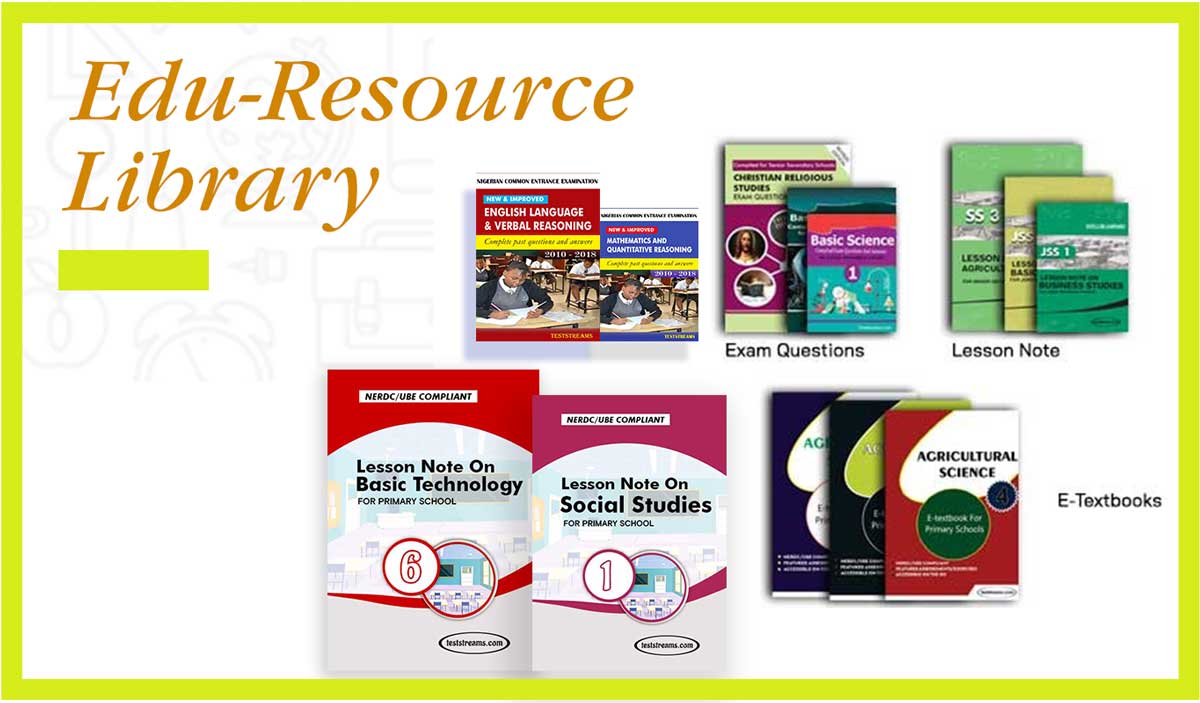
Click the links below to get any resources you want.
- Lesson note for primary and secondary schools
- Exam questions for primary and secondary schools
- Etext books for primary schools
- Common Entrance Math Exam Questions and Answers
- Common Entrance Questions and Answers English and Verbal
- UTME Exam Preparation
- BECE and JSCE past questions
- SSCE / WAEC Past questions
[/su_column][/su_row]